


●Page Headline: How Buffer ETFs Work: Protecting Your Portfolio Without Leaving Stocks
●Page Headline 2: Why Buffer ETFs are Becoming One of the Fastest-Growing ETF Categories
●SEO Headline: What are Buffer ETFs? A Complete Guide to Defined-Outcome Investing
●SEO Headline 2: Buffer ETFs Explained: Pros, Cons, and How They Compare to Traditional ETFs
●Primary keyword/URL: buffer ETFs
● Secondary keywords: how do buffer ETFs work, what are buffer ETFs, defined-outcome ETFs, structured outcome ETFs, are buffer ETFs a good investment, buffer ETFs vs structured notes, buffer ETFs vs traditional ETFs, buffer ETFs vs fixed indexed annuity
●Intro Excerpt: Learn how buffer ETFs work, their downside protection, upside caps, and whether they're a smart investment for today's markets.
●Meta: Learn how buffer ETFs work, their downside protection, upside caps, and whether they're a smart investment for today's markets.
You have probably met one of those people who prefer to keep their money in a savings account rather than to invest it in the stock market. Or maybe you are one of them.
Though these people understand that the stock market could provide more returns, they are just not ready to stomach the risk that often comes with it. Anyone who has seen what happens during a financial crisis or even a bear market can empathize.
But what if one can invest in the stock market in a way that limits one’s exposure to market downturns without directly handling the complexities of derivatives?
That’s the promise of buffer ETFs.
These ETFs protect you against a certain percentage of losses, thereby reducing your exposure to market risk. While these ETFs might use complex strategies to achieve this internally, all you must do as an investor is purchase them on the stock exchange market just like you buy any other stock.
But how do buffer ETFs really work, and what is the tradeoff for this downside protection? We answer these and many other relevant questions below.
- What are buffer ETFs?
- How do buffer ETFs work?
- Buffer ETFs vs structured notes
- Buffer ETFs vs fixed indexed annuities
- The growing popularity of buffer ETFs
- Are buffered ETFs a good investment?
1. What are buffer ETFs?
Buffer ETFs, also known as defined-outcome ETFs, are a type of ETF designed to limit your exposure to downside risk.
They do this by offering guaranteed protection against a certain percentage of market losses over a given period.
For example, FT Vest U.S. Equity Buffer ETF - November (FNOV) is a buffer ETF that offers protection against “the first 10% of underlying ETF losses” between November 24, 2025 and November 20, 2026.
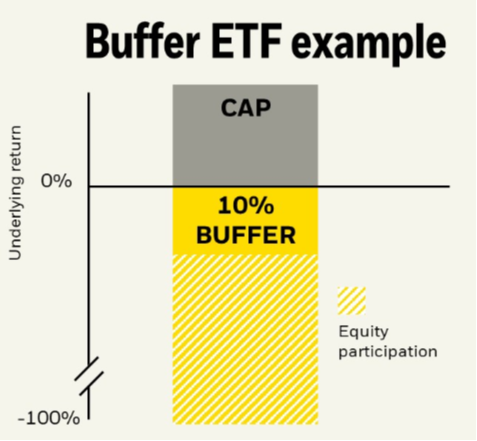
In other words, if market losses don’t exceed 10% within that timeframe, you will never lose money investing in this ETF. Your investment will only start losing money when market losses exceed 10%.
“But doesn’t this constitute a ‘free lunch?’” you ask.
Well, not exactly.
In exchange for the downside risk protection, the ETF caps the gains that you can enjoy in an upside. To continue with the example above, FNOV caps upside gains at 16.62% (gross).
Below is a visual image of how buffer ETFs work:
Buffer ETF Example
Source: BlackRock
Buffer ETFs track the performance of a broad market index, usually the S&P 500 Index. With this cap, you can’t participate in the return of the index beyond a certain limit. In other words, even if the S&P 500 Index produced 25% returns between November 24, 2025 and November 20, 2026, investors in FNOV can only enjoy a 16.62% return.
2. How do buffer ETFs work?
For more clarity on what buffer ETFs are, let’s consider how they work in practice.
Holdings
Buffer ETFs rely on derivatives to provide downside risk protection to investors.
As said above, most buffer ETFs track a broad market index like the S&P 500. However, a difference between buffer ETFs and traditional ETFs is that the former does not invest in underlying stocks in the index. Rather, most buffer ETFs invest in Flexible Exchange (FLEX) options, which are exchange-traded option contracts that are tied to the reference index.
A typical buffer ETF will purchase put options, which often provide the downside protection, and then write call options, which provide the income to finance the put options and define the upside cap. Some will also hold cash, T-bills, and other money-market instruments as collateral assets.
Outcome period
Buffer ETFs don’t offer the same buffer and upside cap indefinitely. As we saw with FNOV, there is a defined outcome period, usually one year, during which these apply.
Once the outcome period expires, the ETF will reset and get a fresh buffer and cap that reflects new market conditions. You can decide to sell at this point or remain invested based on the new terms.
Holding throughout the ETF’s term
The 10% protection and 16.62% upside cap on FNOV apply if you purchased the ETF at the beginning of the outcome period (November 24, 2025) and hold till the end.
This is why buffer ETFs are also known as structured-outcome or defined-outcome ETFs. When you buy them, you have a pre-set return range: the downside protection and the upside cap are clear in advance.
Buying and selling mid-period
When you buy a buffer ETF mid-period, the advertised buffer and cap will not apply to you in full since the market has shifted since the beginning of the outcome period.
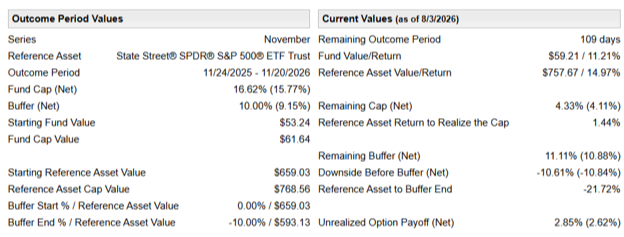
For most buffer ETFs, you can find the remaining outcome period, upside cap, and buffer (downside protection) on the fund’s homepage. For example, at the time of writing, FNOV has 109 days remaining of the outcome period. If you buy at this time, your upside will be capped at 4.33% (gross), and you will enjoy an 11.11% buffer (gross).
FNOV’s Current Valuation
Source:FT Vest
Dividend?
Since buffer ETFs don’t own underlying stocks, they don’t pay dividends.
Said differently, you can only make money through capital appreciation. This will happen if you sell at a higher price mid-period or earn the capped return at the end of the outcome period.
What about laddered buffer ETFs?
We saw that buffer ETFs have a defined period during which the buffer and the upside cap apply. If you don’t buy at the beginning of this period, you must buy mid-period.
Laddered buffer ETFs solve this problem by holding multiple buffer ETFs with staggered reset dates. Like a bond ladder, laddered buffer ETFs provide continuous, rolling protection and upside caps, which makes it unnecessary to time your entry.
For example, FT Vest Laddered Deep Buffer ETF (BUFD) invests in 12 buffer ETFs with different outcome periods. At the time of writing, the remaining outcome period on these ETFs ranges from 18 to 347 days.
This implies that every month, one underlying ETF will rest with fresh buffers and caps. At any given period, you will always have exposure to some ETFs early in their period, in the middle of their period, and near the end of their period. This provides smoother protection and more consistent upside over your investment horizon.
3. Buffer ETFs vs structured notes
Anyone familiar with debt markets would probably have picked up some similarities between buffer ETFs and structured notes.
Structured notes are debt securities usually issued by banks and other financial institutions.
There are two components of a structured note:
●Bond-like component: This component provides the principal repayment at the note’s maturity. The issuer guarantees the repayment of some or all the principal, depending on whether it’s a “principal-at-risk” note or a “principal-protected” note.
●Derivative component: This component involves the purchase of options on a stock index, a single stock, commodities, or a basket of securities. While the bond-like component offers the principal protection, the derivative component provides the upside or gains.
Structured notes often have maturities from one to seven years. Like buffer ETFs, the principal protection they offer comes at the cost of a cap on the upside. This is often in the form of a participation rate. For example, if a structured note that tracks the S&P Index has an 80% participation rate, you will only earn a 24% return when the S&P Index rises by 30%.
What then are the differences between buffer ETFs and structured notes? We consider a few below:
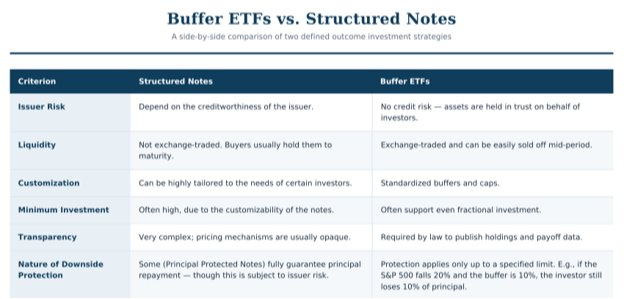
●Issuer risk: Structured notes depend on the creditworthiness of the issuer. Buffer ETFs do not have this credit risk since their assets are held in trust on behalf of investors.
●Liquidity: Structured notes are not exchange-traded. Buyers usually hold them to maturity. On the other hand, buffer ETFs are exchange-traded and can be easily sold off mid-period.
●Customization: As the name implies, structured notes can be highly tailored to the needs of certain investors. In contrast, buffer ETFs have standardized buffers and caps.
●Minimum investment: Due to the customizability of structured notes, they often have high minimum investment requirements. This is unlike buffer ETFs that often support even fractional investment.
●Transparency: Structured notes are very complex, and their pricing mechanisms are usually opaque. On the other hand, buffer ETFs are required by law to publish their holdings and payoff data.
●Nature of downside protection: Some structured notes (Principal Protected Notes) completely guarantee principal repayment (though this is subject to issuer risk). In other words, you won’t lose money irrespective of what happens in the market.
In contrast, buffer ETFs offer downside protection only up to a specified limit. If the S&P 500 Index falls by 20% in each outcome period and your buffer ETF only offers a 10% buffer, then you’ll still lose 10% of your principal.
4. Buffer ETFs vs fixed indexed annuities
Many investors may be unfamiliar with structured notes since they are a niche product. But anyone with some knowledge of retirement planning has probably heard about fixed indexed annuities, or at least of annuities in general.
Fixed indexed annuities are insurance contracts issued by life insurers.
Like some structured notes, they offer full principal protection if held to term. Their gains are generally tied to a stock index, but enjoyment of the index’s return is capped at a given rate or with a participation rate.
Fixed indexed annuities are popular with retirement savers, especially those seeking both reasonable income and capital preservation.
Like structured notes, they are backed by the insurer's guarantees, which means the principal protection depends on the solvency of the issuer.
Below are the differences between buffer ETFs and fixed indexed annuities:
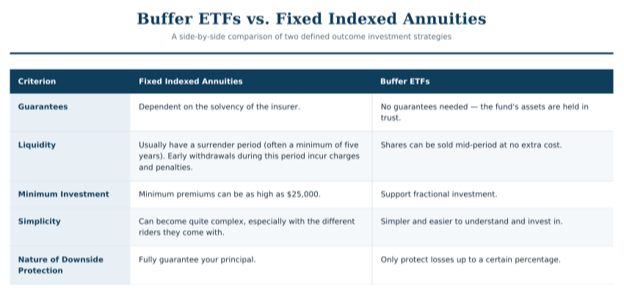
●Guarantees: Fixed indexed annuities are dependent on the solvency of the insurer. Buffer ETFs do not need guarantees as the fund’s assets are held in trust.
●Liquidity: Fixed indexed annuities usually have a surrender period (often a minimum of five years). Early withdrawals during this surrender period will incur charges and penalties. On the other hand, you can sell shares in a buffer ETF mid-period at no extra cost.
●Minimum investment: Fixed indexed annuities have minimum premiums that can be as high as $25,000. In contrast, buffer ETFs support fractional investment.
●Simplicity: Fixed indexed annuities can become quite complex, especially with the different riders they come with. Buffer ETFs, on the other hand, are simpler and easier to understand and invest in.
●Nature of downside protection: Fixed indexed annuities fully guarantee your principal. On the other hand, buffer ETFs only protect losses up to a certain percentage.
5. The growing popularity of buffer ETFs
When market uncertainty and volatility heighten, investors become more concerned about downside protection. Instead of focusing on absolute returns, there is a shift towards risk-adjusted returns.
In the early part of 2026, market uncertainty and volatility have come from geopolitics and AI disruption, according to BlackRock. For them, despite potential risks, the general macroeconomic environment supports staying invested in equities.
What then is the solution? How do you stay invested in equities while aware of rising uncertainty and volatility?
“During periods of heightened volatility and uncertainty, advisors may consider buffer ETFs to seek greater predictability through the uncertainty of markets,” they noted. “Buffer ETFs can help provide a defined level of downside protection should markets continue to dip but also can position portfolios for a rebound by capturing market upside up to a cap over a specific outcome period.”
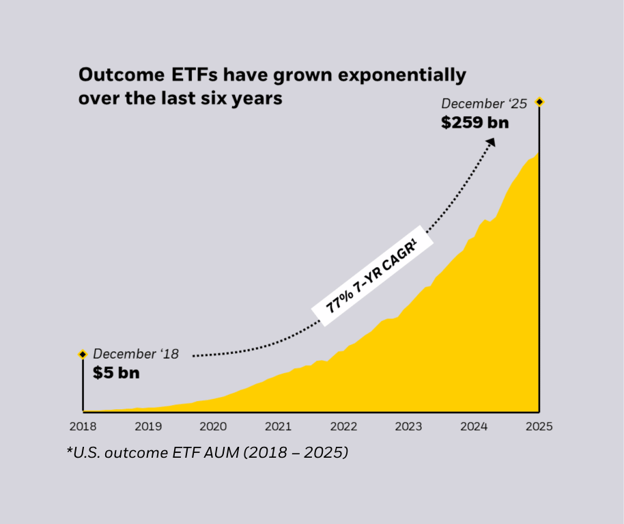
As the chart below shows, outcome (buffer) ETFs in the US grew from $5 billion in assets under management (AUM) in December 2018 to $259 billion, a 77% compounded annual growth rate (CAGR).
Growth of Defined-Outcome ETFs, 2018-2025
Source: BlackRock
Also, at a 50% year-on-year (YoY) growth rate, buffer ETFs were one of the fastest-growing ETF segments in 2025, according to BlackRock.
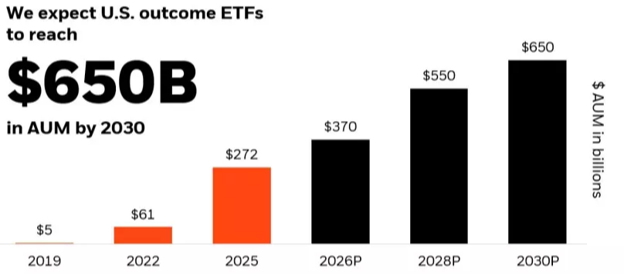
No wonder that at the end of 2025, they projected that outcome ETFs would reach $650 billion in AUM by 2030.
Projected Growth of Outcome ETFs
Source: BlackRock
They expect this growth to be supported by “product innovation, changing demographics and market dynamics.” Also, with 90% of advisors not yet using them as of March 2025, any spur in interest among advisors can lead to rapid adoption.
We can also explore the growth of buffer ETFs in terms of supply.
About 468 structured outcome ETFs traded on US exchanges at the end of November 2025, according to FactSet Insight. Also, more than $1 billion flowed into these funds in that month. Of these, 113 were launched in 2025.
6. Are buffered ETFs a good investment?
Buffer ETFs have become popular because investors find them valuable for various reasons. We consider some of these below:
●Cushioning volatility amid the weakness of bond-stock portfolios: Investors have typically depended on bond-equity portfolios to enjoy the high returns of the stock markets while smoothing out their fluctuations and volatility.
However, the correlation between equity and bonds have increased, making bonds less effective as equity diversifiers. “In 2022 as inflation spiked, stocks and bonds fell together – leaving balanced portfolios of 60% equities and 40% bonds with their worst year since 2008,” according to J.P Morgan.
Consequently, investors need a new source of diversification.
“Investors still want and need equity growth, but it’s increasingly important to have other sources of diversification to cushion volatility,” they continued. “Buffer ETFs are one such tool: they don’t replace fixed income, but they can complement it by reshaping the way equity exposure is experienced.”
●Helping investors stay invested during market downturns: “The average man tends to buy high and sell low,” said Ray Dalio, a legendary investor and founder of Bridgewater Associates, a popular hedge fund.
One of the reasons for this is that many investors sell when there is a market downturn in fear of losing a significant part of their portfolio. Yet, experienced investors have found that time in the market is more important than timing the market, and staying in the market through its highs and lows is often the way to build long-term wealth.
By limiting downside risk, buffer ETFs can give you more confidence to stay in the market and ride out its fluctuations instead of selling low to cut losses (and end up missing the market’s best performing days)
●Enjoying downside risk protection without illiquidity: Structured notes and fixed indexed annuities also provide downside protection, but they are illiquid. Buffer ETFs offer similar (though unidentical) benefits without the illiquidity.
●Boost capital appreciation for conservative investors: For conservative investors, minimizing risk is the priority. Nevertheless, there are many low-risk, high return assets that allow them to earn decent returns while achieving that priority – dividend stocks, investment-grade corporate bonds, municipal bonds, etc.
Buffer ETFs also belong on that table. While minimizing downside risk, they provide index-linked returns (even with the cap) that is better than savings accounts and fixed-income securities.
Despite these benefits, there are some reasons to be cautious about buffer ETFs:
●Downside protection is not absolute: Unlike structured notes and fixed indexed annuities, there is still a risk of losing a portion of your principal if the market falls deeper than the buffer.
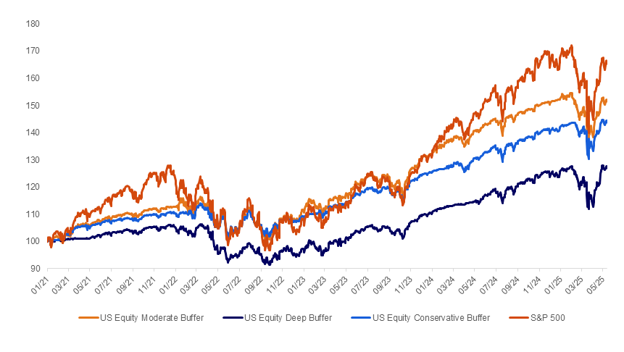
●Lower returns: As seen in the chart below, buffer ETFs tend to underperform the S&P 500 Index:
Buffer ETFs vs the S&P 500 Index
Source: Russell Investments
But this information might not be that relevant if you are a conservative investor who is more concerned about minimizing risk or investing with a peace of mind rather than maximizing absolute returns.
●The problem of buying mid-period: We have seen that buying a buffer ETF mid-period changes the dynamics, depending on current market conditions. The cap and buffer will be different, and it might be favorable or not.
However, this problem can be solved with the use of laddered buffer ETFs. These eliminate the need for market timing when purchasing buffer ETFs.
Whether the pros outweigh the cons, or vice versa, depends on your personal situation.
If buffer ETFs interest you, you should talk to your financial advisor about the place they can play (if any) in your portfolio. They will be in the better position to give you specific advice based on your time horizon, financial goals, and risk tolerance.
Remember that there is no free lunch and every portfolio decision should be made with a thorough and contextual evaluation of the pros and cons.
Takeaways
● Buffer ETFs help reduce downside risk. They protect against a predefined level of market losses while allowing investors to remain invested in equities.
● Protection comes with a tradeoff. In exchange for downside buffers, investors accept a cap on potential upside returns.
● They differ from structured notes and annuities. Buffer ETFs offer greater liquidity, transparency, and lower investment minimums, but they don't provide full principal protection.
● Demand is growing rapidly. Rising market volatility and investor demand for risk-managed equity exposure have made buffer ETFs one of the fastest-growing ETF categories.